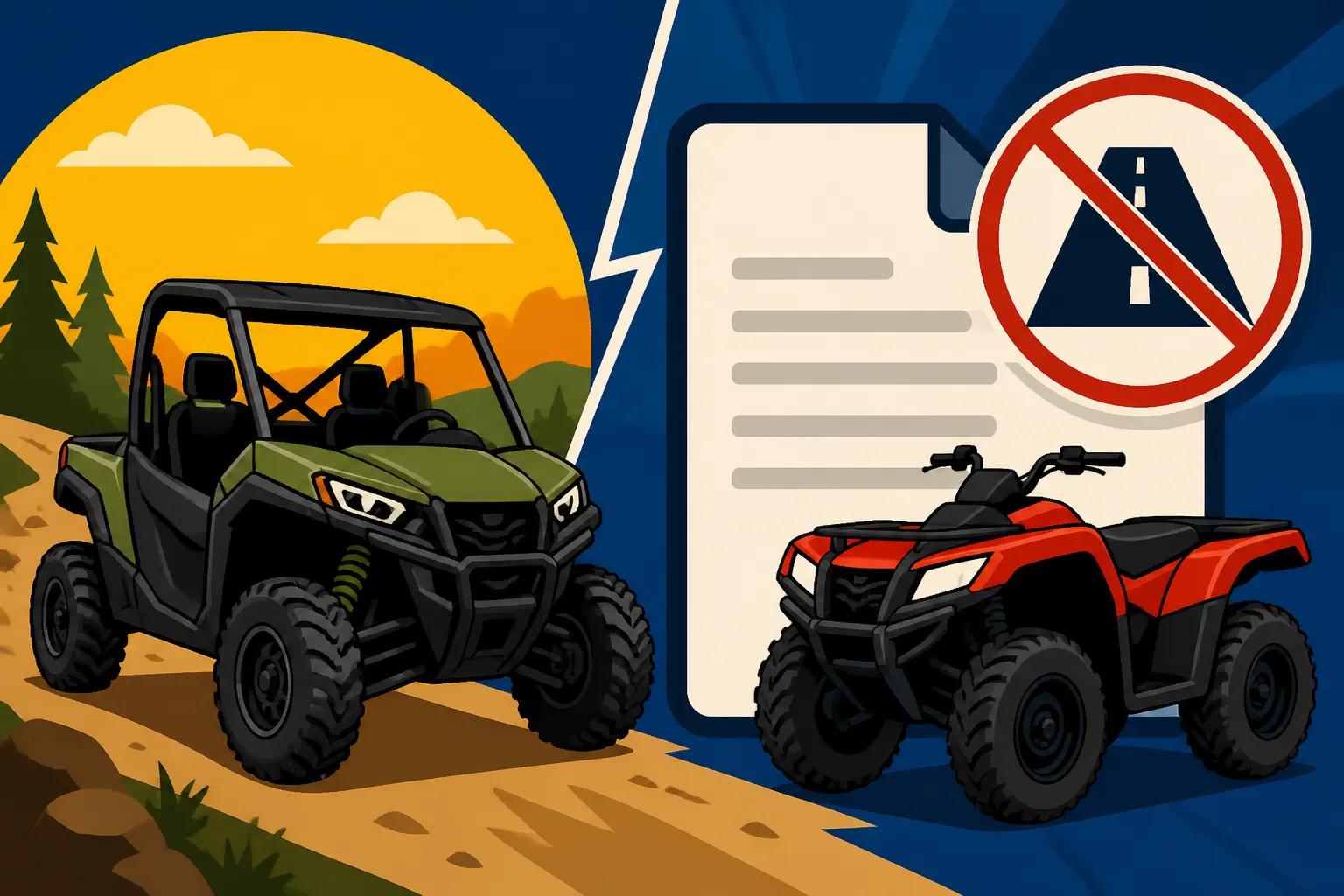
The Off-Highway Use Only Remark on a Texas Title
It's a common moment of confusion for many new off-highway vehicle (OHV) owners in Texas: you finally get your hands on that shiny new (or new-to-you) ATV or UTV title, only to see a prominent, sometimes unsettling, phrase stamped or printed right there: "Off-Highway Use Only." This seemingly simple remark can cause a lot of head-scratching, leading riders to wonder if their machine is somehow less legitimate, or if it means they can never, ever put a tire on a public road. This comprehensive guide is here to unravel the mystery of this specific Texas title remark, explaining exactly what it means for your ownership, your riding habits, and your peace of mind.
Understanding the "Off-Highway Use Only" Remark
When you receive a Texas title for an ATV, UTV, or other off-highway vehicle, that "Off-Highway Use Only" stamp isn't just a suggestion; it's a critical legal designation. It sets your machine apart from typical street-legal cars, trucks, and motorcycles, clearly defining its intended and permitted operational environment within the Lone Star State. This remark is fundamentally about public safety and the preservation of public infrastructure, ensuring that vehicles designed for rugged terrain stay where they belong – off the main roads, except under very specific circumstances.
What the Remark Actually Means
At its core, "Off-Highway Use Only" signifies that your vehicle is legally designated for operation exclusively off public roads and highways. This means no casual cruising down Main Street, no quick runs to the grocery store, and no commuting to work on your ATV. The design and engineering of ATVs and UTVs—their knobby tires, high ground clearance, suspension systems, and often lack of typical road safety features like turn signals or mirrors—make them inherently unsuitable for the demands of paved roads and shared traffic. They perform brilliantly on dirt, sand, mud, and rock, but those same characteristics make them a potential hazard in a conventional traffic flow. This remark is essentially a permanent, official reminder that your machine is built for the trails, not the tarmac. It's a key distinction that helps the state manage vehicle types and ensure appropriate usage.
The Legal Basis for the Remark
The requirement for the "Off-Highway Use Only" remark stems directly from the Texas Transportation Code. Specifically, Chapter 551 defines what constitutes an "off-highway vehicle" and outlines the regulations governing their use. Unlike cars and trucks, which are both titled and registered for road use, OHVs in Texas are primarily titled as proof of ownership, but they are generally not registered for operation on public roadways. This is a critical distinction many owners struggle with. The state issues a title to establish who owns the machine, which is important for sales, insurance, and theft recovery, but it deliberately refrains from issuing traditional road registration. The "Off-Highway Use Only" remark is the state's way of explicitly stating that while you own this vehicle, that ownership does not grant you the privilege of operating it on public streets, with a few tightly controlled exceptions. For more on this, you might find [Why Texas Titles But Never Registers an OHV] to be a helpful read.
Where You'll See It on Your Title
The exact appearance of the "Off-Highway Use Only" remark can vary slightly depending on when your title was issued, but it will always be prominent. On newer Texas titles, you'll typically find this phrase printed clearly within the vehicle description section or near the top of the title document itself. It might be a dedicated line item, or it could be integrated into the vehicle type or usage description. In some older formats, it might have been a physical stamp applied during the titling process. Regardless of its precise placement or whether it's printed or stamped, its message is unequivocal. It's not hidden in fine print; it's designed to be easily noticed by anyone reviewing the document, whether you're buying, selling, or just looking over your paperwork. When you're filing [The Texas Title Application Every OHV Buyer Files], this designation is implicitly, if not explicitly, applied during processing.
Why Texas Employs This Specific Restriction
Texas, like many states, has a vested interest in ensuring public safety and maintaining its vast network of roads. The "Off-Highway Use Only" remark isn't an arbitrary rule; it's a thoughtful, pragmatic approach to distinguishing vehicles designed for different purposes and mitigating risks. The very nature of an OHV, while fantastic for off-road adventures, presents challenges when introduced into a conventional road environment.
Protecting Public Roads and Infrastructure
Imagine a vehicle with aggressive, low-pressure knobby tires designed to grip loose dirt, mud, and rocks. Now imagine that same vehicle driving repeatedly on hot asphalt or concrete. Those tires, while perfect for traction off-road, can cause accelerated wear and tear on paved surfaces. Furthermore, the suspension systems of ATVs and UTVs are typically designed for absorbing impacts from uneven terrain, not for stable, high-speed cornering or emergency braking on hard surfaces alongside cars. The cumulative effect of numerous OHVs operating on public roads could lead to increased maintenance costs for state and local governments. Beyond the physical wear, the significant difference in size, speed capabilities, and handling characteristics between OHVs and road-legal vehicles creates a substantial safety disparity. These machines simply aren't engineered for the demands of the road, and the "Off-Highway Use Only" remark is a clear boundary.
Clarifying Vehicle Classification
Texas has a robust system for classifying different types of vehicles, and this remark plays a crucial role in preventing confusion. Without it, there might be ambiguity about whether a specific machine is intended for road use or not. This is particularly important when considering other niche vehicle categories. For example, Low-Speed Vehicles (LSVs) or Neighborhood Electric Vehicles (NEVs) are specifically designed and manufactured to meet certain federal safety standards for limited road use, often with speed restrictions. Golf carts, too, have their own distinct set of rules for road operation in certain communities. The "Off-Highway Use Only" stamp clearly tells anyone looking at the title that this particular ATV or UTV does not fall into those street-legal categories. It's a definitive identifier, helping to keep the lines clear between different types of machines and their permitted operational environments. Knowing [What Texas Counts as an Off-Highway Vehicle] is key to understanding this classification.
Preventing Unintended Road Use
One of the biggest pain points for many new OHV owners is the desire to take their machine "just down the road" to a trail, a friend's house, or a local store. The "Off-Highway Use Only" remark is a direct deterrent to this kind of unintended, and often illegal, road use. It serves as an official declaration that simply owning the title to an ATV or UTV does not grant permission for road travel. While a title is indeed proof of ownership, essential for things like insurance or selling your machine, it does not equate to a license to operate on public streets. The state is trying to prevent situations where riders might mistakenly believe their titled vehicle has the same privileges as a registered car. This proactive measure aims to reduce accidents, protect riders, and ensure the orderly flow of traffic by clearly demarcating what is, and is not, a road-legal vehicle in Texas. This clarity is why [Why Texas Will Not Register an ATV for the Road] is such a consistent policy.
The Impact on Owners and Buyers
The "Off-Highway Use Only" remark isn't just a bureaucratic label; it has tangible implications for both current owners and prospective buyers of ATVs and UTVs in Texas. Understanding these impacts can help you make informed decisions about where and how you ride, as well as how you approach buying or selling your machine.
Limitations on Public Road Operation
The most immediate and obvious impact of the "Off-Highway Use Only" remark is the stringent limitation it places on operating your OHV on public roads and highways. For the vast majority of riders, this means trailering your ATV or UTV to and from your riding destinations. You can't simply hop on your quad and drive it down a county road to get to a nearby riding park or a friend's ranch. While Texas does have some highly specific and limited exceptions for agricultural and timber use, or for crossing roads, these are not blanket permissions for general road travel. Attempting to drive your OHV on public roads outside of these narrow exceptions can result in citations, fines, and even impoundment of your vehicle. It's crucial for every OHV owner to fully grasp this fundamental restriction to avoid legal trouble. If you’re unclear, reviewing [Texas Rules for Riding on a 35 mph Road] could offer more insight into the very specific scenarios allowed.
Resale Value and Buyer Expectations
When you decide to sell your ATV or UTV, the "Off-Highway Use Only" remark on the title can influence both the perceived value and the expectations of potential buyers. Most buyers of OHVs are looking for machines primarily for off-road recreation, so the remark might not deter them. However, it's essential to be completely transparent about this designation during the sale. A new buyer might mistakenly assume that because it has a title, it's street legal, or that some simple modifications can make it so. Clearly communicating that the machine is for off-highway use only helps manage expectations and avoids future disputes. Savvy buyers will appreciate your honesty, and it prevents them from feeling misled. When completing the paperwork, whether you're using a standard Texas bill of sale or a template from a service like LawDepot, ensuring the buyer understands this designation is a good practice. Properly executing the transfer, including [Selling an OHV and Signing a Texas Title], means addressing these aspects upfront.
Insurance Implications
The "Off-Highway Use Only" designation also has a direct bearing on your insurance coverage. Because these machines are not considered road-legal vehicles, they typically cannot be insured under a standard automotive policy. Instead, you'll need a specialized off-road vehicle insurance policy. These policies are tailored to cover the unique risks associated with off-highway riding, such as accidents on trails, theft from a remote location, or damage while being trailered. It's vital to have the correct type of insurance to protect your investment and yourself. If you were to operate your OHV on a public road where it's not legally permitted and get into an accident, your off-road policy might deny coverage, arguing that you were operating the vehicle outside its intended and legal parameters. Always speak with an insurance professional to ensure your policy aligns with your vehicle's designation and your intended use. While Texas does not mandate liability insurance for OHVs operating strictly off-road, it's highly recommended for peace of mind.
Navigating Exceptions to the Road Restriction
While the "Off-Highway Use Only" remark is a strict limitation, Texas law does provide a handful of very specific, narrowly defined exceptions where an OHV might legally touch a public road. These aren't loopholes for joyriding; they are practical allowances for necessary tasks, primarily in rural or agricultural settings, or for basic transit across a barrier.
Agricultural and Timber Exemptions
One of the most significant exceptions for OHV road use in Texas is tied to agricultural and timber operations. Farmers, ranchers, and those involved in timber production can use their ATVs or UTVs on public roads to transport agricultural products, livestock, farm equipment, or for other bona fide agricultural or timber purposes. This means hauling feed to cattle, checking fence lines, or moving supplies between fields. However, this isn't an open invitation for unrestricted road travel. There are usually stipulations, such as operating during daylight hours, ensuring the vehicle has proper lighting (like headlights and taillights) even during the day, and often displaying a slow-moving vehicle emblem or an orange flag for visibility. The primary purpose must be agricultural or timber-related, not recreational. If you operate your ATV on a public road under this exemption, you're expected to be actively engaged in farm or timber work. For detailed information, see [Texas Agricultural Exemption for ATVs on Roads].
Local Government Ordinances
Another area where OHV road access might be permitted, albeit rarely and under strict control, is through local government ordinances. Texas law allows certain counties, particularly those with smaller populations (generally under 37,000 residents), to adopt ordinances that permit the operation of OHVs on designated public roads within their jurisdiction. These are typically very specific and may apply only to certain types of roads, at certain times, or for particular purposes, such as accessing a local lake or riding area. Similarly, some cities, especially those with master-planned communities, might have provisions for golf carts or utility vehicles on specific internal streets, though this often requires them to meet certain safety equipment standards (like lights, turn signals, and seat belts) that go beyond a typical off-highway vehicle. It's absolutely critical to remember that these are local rules and do not apply statewide. Always check with the specific county or city government before assuming you can ride on their roads. Relying on hearsay can lead to significant fines. Exploring [Which Texas Counties May Open Roads] can provide context.
Crossing Public Roads
Even with the "Off-Highway Use Only" designation, Texas law acknowledges that OHV riders sometimes need to briefly cross a public road or highway to get from one section of private land to another, or to access an approved riding area. This is a very limited exception, and it comes with strict safety protocols. When crossing, an OHV operator must do so at a right angle to the road, make a complete stop before entering the roadway, yield to all oncoming traffic, and proceed safely without impeding traffic flow. It's not a free pass to drive along the road, even for a short distance; it's solely for direct traversal. You must have clear visibility in both directions and cross at the safest possible point. Any deviation from these rules—like driving down the shoulder or cruising for even a hundred feet—can be considered illegal operation. This exception is designed for a quick, necessary crossing, not for extended travel. The guidelines in [Crossing a Highway on an ATV in Texas] are important to review for safety and legality.
Titling Process and the "Off-Highway Use Only" Remark
Understanding how the "Off-Highway Use Only" remark becomes part of your vehicle's title is crucial, whether you're buying a brand-new machine or transferring ownership of a used one. The process ensures that all OHVs intended for off-road recreation are correctly identified in state records from the outset.
How the Remark Appears on a New Title
When you purchase a brand-new ATV or UTV from a dealership in Texas, the titling process typically begins there. The dealer will handle the paperwork, including collecting sales tax and submitting the necessary forms to the Texas Department of Motor Vehicles (TxDMV) or directly to the county tax assessor-collector's office. During this initial titling application, the vehicle's classification as an "off-highway vehicle" is established. Because these machines do not meet the safety and equipment standards for road registration, the TxDMV automatically affixes the "Off-Highway Use Only" designation to the title before it's issued. This happens by default for all new ATVs, UTVs, and similar OHVs. You won't typically need to request it, nor can you request its removal. It's an inherent part of the titling for this class of vehicle. This process is integral to [Titling an ATV in Texas] and ensures correct classification from the start.
Titling a Used OHV in Texas
The process for titling a used OHV that already has the "Off-Highway Use Only" remark is generally straightforward. When you buy a used ATV or UTV from a private seller, the seller will sign over their existing Texas title to you. This title will already bear the "Off-Highway Use Only" designation. When you take this signed title, along with a completed Form 130-U (Application for Texas Title and/or Registration) and proof of sales tax payment (or an exemption), to your county tax assessor-collector's office, the new title issued in your name will also carry this same remark. It essentially transfers with the vehicle, ensuring that its off-highway designation remains consistent through changes of ownership. As a buyer, it's wise to visually confirm this remark on the seller's title before finalizing the purchase, so you know exactly what you're getting. Checking [Buying a Used ATV in Texas] provides more advice on this.
What Happens if a Title Lacks the Remark
Occasionally, a used OHV might come with an older title that doesn't explicitly state "Off-Highway Use Only," or it might have an out-of-state title. This can happen if the machine was titled before the remark became standard practice, or if it's being imported from a state with different titling conventions. In such cases, when you apply for a new Texas title, the vehicle will be classified based on its type (e.g., ATV, UTV) and its intended use. If it fits the Texas definition of an off-highway vehicle, the "Off-Highway Use Only" remark will almost certainly be added to your new Texas title, even if it wasn't on the previous one. The state aims for consistency in its classification system. This ensures that all OHVs within Texas's titling system are correctly identified and subject to the same operational restrictions. This proactive application helps prevent any ambiguity about a vehicle's legal status on Texas roads. The critical step is submitting the appropriate paperwork, like [The Texas Title Application Every OHV Buyer Files], which triggers this classification review.
Common Misconceptions and Advice for Riders
The "Off-Highway Use Only" remark often leads to confusion and common misunderstandings among riders. It's easy to assume that because you have a piece of paper that says "title," it grants certain privileges. Dispelling these myths and adopting best practices will keep you on the right side of Texas law.
The Difference Between Titling and Registering
One of the biggest sources of confusion is the difference between titling and registering a vehicle. A title is a legal document that proves ownership of a vehicle. It's essential for buying, selling, and insuring your ATV or UTV. A registration, on the other hand, is generally what grants a vehicle permission to operate on public roads. It usually involves annual fees and ensures the vehicle meets specific safety and emissions standards for road use. For ATVs and UTVs in Texas, you get a title, but you do not get a standard road registration. The "Off-Highway Use Only" remark is precisely there to emphasize this distinction: you own it, but you can't register it for street use. Many states have this two-tiered system, and understanding it is key to being a responsible OHV owner in Texas. If you're still grappling with this, [Why Texas Titles But Never Registers an OHV] provides a deeper dive into this specific legal framework.
Modifying an OHV for Road Use
It's a persistent myth that by adding certain accessories—like turn signals, a horn, mirrors, or even changing to street-friendly tires—you can magically make your "Off-Highway Use Only" ATV or UTV street legal in Texas. This is simply not true. While these accessories might improve safety or visibility off-road, they do not change the fundamental legal classification of your vehicle. The state's definition of an OHV, and thus its "Off-Highway Use Only" designation, is based on its original manufacturer's design and purpose, not on aftermarket modifications. Even if your machine appears to have all the components of a street-legal vehicle, it still cannot be registered for road use in Texas as an ATV or UTV. Attempting to drive a modified OHV on public roads will still result in the same citations as an unmodified one. Focus your modifications on improving your off-road experience and safety, not on trying to skirt the law. For further clarity, [Why Modifying an ATV Will Not Make It Street Legal] explains this policy in detail.
Best Practices for OHV Owners
As an OHV owner in Texas, embracing best practices will ensure a safe and legal riding experience. First and foremost, always carry proof of ownership (your title or a copy) when transporting your OHV, especially if you're crossing county lines or riding in public parks. This helps if you're ever stopped or need to prove the machine belongs to you. Secondly, familiarize yourself with all local and state laws regarding OHV operation, including specific rules for public parks, trails, and any unique county ordinances. Always check the rules of any riding park before you go, as they may have their own requirements for permits, decals, or safety gear. Finally, always use a clear and comprehensive bill of sale for any private OHV transactions. This not only protects both the buyer and seller but also clearly documents the terms of the sale, including the transfer of an "Off-Highway Use Only" title. You can find excellent customizable templates for a [A Texas Bill of Sale for an ATV] through services like LawDepot, which can make the process simpler and more secure.
Future Outlook for Texas OHV Laws
The landscape of off-highway vehicle laws is dynamic, with ongoing discussions and evolving needs. While the "Off-Highway Use Only" remark has been a cornerstone of Texas OHV titling for years, it's natural for riders to wonder about potential changes down the road. Understanding the forces that shape these laws can provide some perspective.
Potential Legislative Changes
Each legislative session, lawmakers in Texas may introduce bills related to vehicle regulations, including those pertaining to OHVs. These proposals can come from various sources: constituents, advocacy groups, or state agencies responding to new challenges or safety concerns. While there have been discussions over the years about expanding OHV access or modifying titling/registration requirements, the core principle of "Off-Highway Use Only" for the vast majority of ATVs and UTVs has remained remarkably consistent. Major shifts in policy typically require significant legislative consensus and are often driven by compelling safety data or widespread public demand. As of now, any radical changes that would suddenly make all titled OHVs street-legal seem unlikely, given the inherent design differences and safety considerations that underpin current law. It's always a good idea to stay informed through official state channels, but avoid making riding decisions based on unconfirmed rumors.
The Role of Advocacy Groups
Off-highway vehicle advocacy groups play a vital role in representing the interests of riders and working with legislators. Organizations such as the Texas Motorized Trails Coalition (TMTC) and others actively engage in discussions about OHV land access, safety education, and proposed legislative changes. These groups often champion initiatives that promote responsible riding, expand access to designated off-road areas, and clarify existing laws. While they might advocate for specific allowances, such as more clearly defined routes or expanded exceptions for certain communities, their work often centers on practical solutions that respect both rider needs and public safety. Their efforts help ensure that the voice of the OHV community is heard in Austin, providing a balanced perspective on how these machines are used and regulated. These groups are often the first to report on any serious legislative efforts that could impact the "Off-Highway Use Only" designation.
Why the "Off-Highway Use Only" Remark is Likely Here to Stay
Considering the fundamental reasons behind the "Off-Highway Use Only" remark – public safety, road preservation, and clear vehicle classification – it's highly probable that this designation will remain a permanent fixture on Texas OHV titles for the foreseeable future. The distinct design differences between an ATV/UTV and a street-legal vehicle are not going away. The infrastructure of public roads is not suddenly going to become compatible with off-road tires and suspensions without significant safety compromises. While minor adjustments to specific exceptions or localized ordinances might occur over time, the core principle that an OHV is primarily for off-road environments is deeply ingrained in Texas law. This consistency provides clarity for law enforcement, vehicle administrators, and riders alike, ensuring that the primary purpose and limitations of these powerful machines are always transparently communicated. It's a system designed to protect everyone.
Summary of Texas Vehicle Designations
To help clarify the differences between various vehicle types and their associated road-use privileges in Texas, here's a quick comparison:
| Feature/Category | Off-Highway Vehicle (ATV/UTV) | Low-Speed Vehicle (LSV/NEV) | Standard Passenger Vehicle (Car/Truck) |
|---|---|---|---|
| Title Issued | Yes | Yes | Yes |
| Road Registration | No | Yes | Yes |
| "Off-Highway Use Only" Remark | Yes, on title | No | No |
| Primary Use | Off-road recreation, agriculture, utility | Limited street use, neighborhood travel | General public road transportation |
| Top Speed (Approx.) | Varies greatly, often 50+ mph | Typically 20-25 mph | 65+ mph |
| Required Safety Features for Road Use (if applicable) | Minimal (exceptions exist) | Headlights, taillights, turn signals, seat belts, mirrors, VIN | Extensive (airbags, ABS, etc.) |
| Insurance Type | Specialized Off-Road Policy | Standard Auto Policy | Standard Auto Policy |
| Permitted on Highways | No (except for limited crossing) | Generally no, unless posted 35 mph or less | Yes |
| Agricultural/Timber Exemption for Road Use | Yes (under strict conditions) | No | N/A |
This table highlights the clear legal distinctions that separate your beloved ATV or UTV from other vehicles on Texas roads. The "Off-Highway Use Only" remark is a fundamental part of placing your machine squarely in the off-road category.
Disclaimer
This article is for general informational purposes only and does not constitute professional advice. Laws, prices and regulations vary by location and change over time. Consult a qualified professional for guidance on your specific situation.